Disclaimer: AureX Tek does not operate, promote, or endorse any public investment scheme. The company has not authorized any individual, entity, or organization to solicit, collect, or accept funds or investments on its behalf. Any such activity is unauthorized and undertaken at the sole risk of the individual involved.

Non-Human Identity Security: The Hidden Cyber Risk Behind AI, APIs, Bots, and Automation
A very important perspective from AureX Tek on one of the fastest growing cybersecurity blind spots: Non-Human Identity Security. As AI agents, APIs, bots, cloud workloads, and automation become part of daily enterprise operations, organizations must rethink identity governance beyond human users. The future of cybersecurity will depend on how well we control every identity operating inside the enterprise.
Faisal Mahmud
6/13/20267 min read
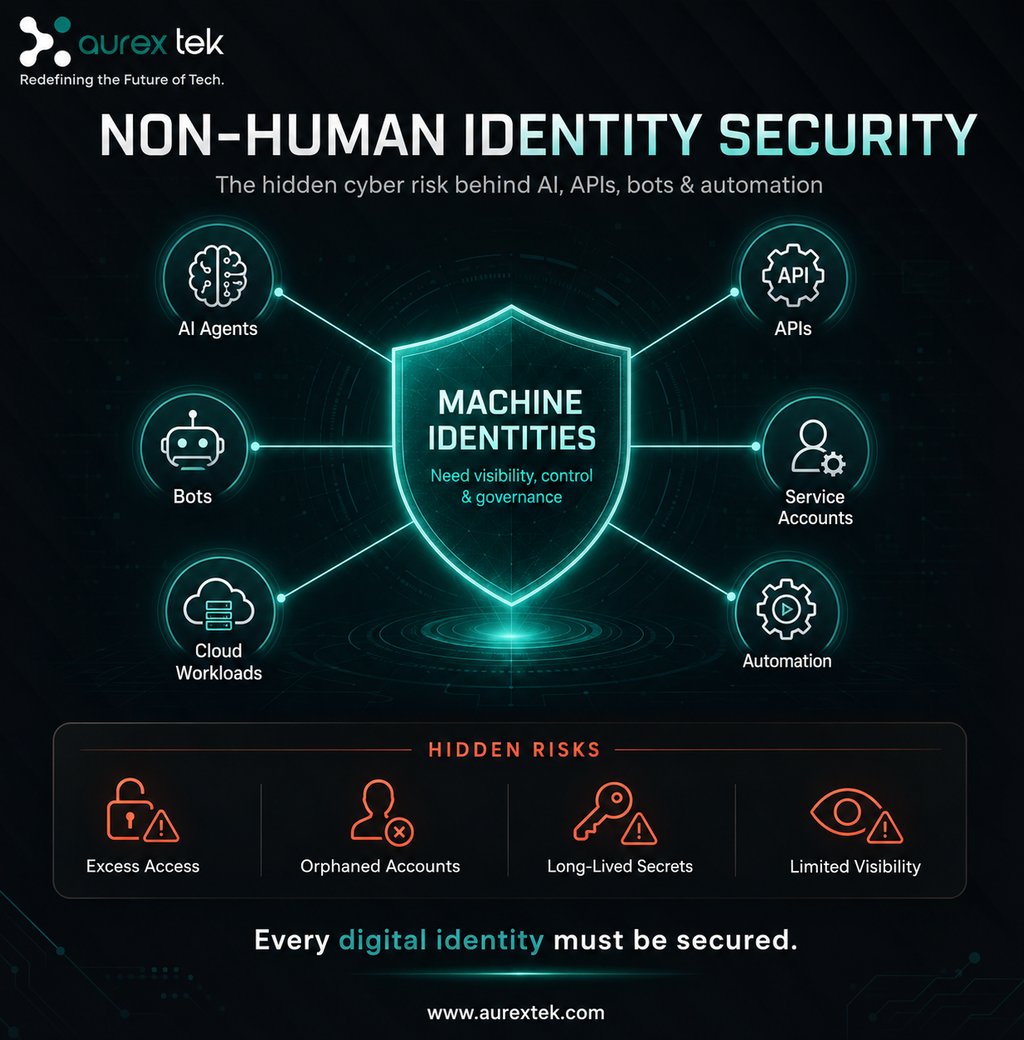
My post content For years, enterprise cybersecurity has been built around one central question:
Who is the user?
The entire security model evolved around human identity employees, contractors, administrators, partners, customers, and privileged users. We invested in multi-factor authentication, single sign-on, privileged access management, role-based access control, identity governance, and user behavior monitoring.
But the modern enterprise is no longer operated only by humans.
Today, businesses are being run by APIs, bots, scripts, cloud workloads, service accounts, CI/CD pipelines, robotic process automation, containers, microservices, machine identities, and now AI agents that can reason, decide, and execute actions across business systems.
This creates a new strategic cybersecurity question for CXOs:
Who is securing the identities that do not belong to humans but can still access critical systems, move data, trigger transactions, and impact business operations?
This is the emerging risk of Non-Human Identity Security.
It is one of the most underestimated cybersecurity challenges facing modern enterprises.
The Enterprise Has Become Machine-Operated
Digital transformation has changed the operating model of the enterprise.A customer action on a mobile app may trigger multiple APIs. An automated workflow may update a CRM. A cloud workload may access customer data. A DevOps pipeline may deploy code into production. A bot may process invoices. An AI agent may retrieve information, call internal tools, generate recommendations, and execute tasks.
Behind every one of these actions is an identity.Not always a person. Often a token, key, certificate, service account, workload identity, OAuth app, automation credential, bot identity, or AI agent credential.
These identities are non-human, but their access can be extremely powerful.
In many organizations, non-human identities already outnumber human users. Yet they are often less visible, less governed, less frequently reviewed, and more likely to be over-privileged. That is the risk. The enterprise has automated operations faster than it has automated identity governance.
Why Non-Human Identities Are High-Value Targets
Attackers do not always need to compromise a CEO, CFO, administrator, or employee account.
Sometimes, compromising an exposed API key, service account, automation token, cloud secret, or machine certificate is enough. A non-human identity can give an attacker access to systems without triggering the same level of suspicion as a human login. It may operate continuously. It may not require MFA. It may not have a clear owner. It may have long-lived credentials. It may be excluded from normal identity reviews. It may have more access than required because “the integration needed to work.” This is why non-human identities are becoming attractive targets. They often combine four dangerous characteristics:
Persistent access. Many machine credentials remain active for months or years.
High privilege. Service accounts and automation tools are frequently granted broad permissions to avoid operational failure.
Limited visibility. Security teams may not know which identities exist, what they access, or which business process they support.
Weak ownership. When an employee leaves, their account is disabled. When a script, bot, or API integration becomes obsolete, its credential may remain alive.
This creates identity debt. And identity debt becomes cyber risk.
AI Agents Are Expanding the Problem
The rise of AI agents makes this issue even more urgent.
Traditional automation followed fixed instructions. AI agents are different. They can interpret goals, select tools, call APIs, retrieve data, generate outputs, interact with systems, and in some cases initiate actions.
This means AI agents are not simply software features. They are becoming digital actors inside the enterprise.
If an AI agent can access email, CRM, ERP, HR systems, knowledge bases, cloud storage, customer records, or financial workflows, then that agent must be governed like a privileged identity.
The risk is not only that an AI model may produce an incorrect answer. The greater risk is that an autonomous or semi-autonomous system may take action using credentials that were never properly governed.
An AI agent with excessive permissions can become an accelerant for data leakage, unauthorized workflow execution, privilege abuse, business logic manipulation, or lateral movement.
In simple terms: AI does not reduce the need for identity governance. It multiplies it.
APIs Are the Execution Layer of the Digital Enterprise
APIs have become the nervous system of modern business.
They connect applications, customers, partners, vendors, platforms, payment systems, mobile apps, cloud services, AI tools, and internal workflows.
But APIs also expose business logic That is why API security is not only a developer issue. It is a business risk issue. When APIs are accessed by non-human identities, the question is not only whether the API is secure. The deeper question is:
Is the calling identity authorized to perform this action, at this time, from this environment, for this purpose, against this data?
This is where many enterprises are exposed. A token may authenticate successfully, but authentication is not the same as authorization. An API may accept a request, but that does not mean the request is appropriate. A bot may execute a workflow, but that does not mean the workflow is safe at scale. An AI agent may call a tool, but that does not mean it should have unrestricted access. The future of API security must be tightly connected with non-human identity governance.
The Real Problem Is Not Identity Creation. It Is Identity Lifecycle Failure.
Most organizations do not fail because they create non-human identities.
They fail because they do not manage the lifecycle. A service account is created for a project. An API key is issued for a vendor integration. A secret is stored in a repository. A bot is configured for a finance process. A cloud workload is granted access to data. An AI agent is connected to enterprise tools.
Then the project changes. The vendor contract ends. The developer moves teams. The application is replaced. The workflow becomes inactive. The agent is no longer used. But the identity remains.This is how machine identities become orphaned, over-privileged, unmonitored, and exploitable.
For CXOs, this is not a small technical weakness. It is a governance failure.
Every non-human identity should have: A defined owner. A business purpose. A risk classification. A least-privilege access model. A credential rotation policy. A monitoring baseline. An expiration or renewal process. A decommissioning trigger.
Without this, organizations are not managing identity. They are accumulating invisible access.
Zero Trust Must Extend Beyond Human Users
Many organizations have adopted Zero Trust as a strategic cybersecurity direction. But in practice, Zero Trust is often applied mainly to employees, devices, and network access.
That is no longer enough. A mature Zero Trust model must include non-human identities.
Never trust an API key just because it exists. Never trust a service account just because it is internal. Never trust a bot just because it supports operations. Never trust an AI agent just because it was approved during a pilot. Never trust a workload just because it runs inside the cloud environment. Every identity human or non human should be continuously verified, contextually authorized, minimally privileged, monitored, and revocable. For non-human identities, this means moving beyond static secrets and broad permissions toward stronger models such as workload identity, short-lived credentials, certificate-based authentication, policy-based authorization, secrets rotation, runtime monitoring, and automated deprovisioning. Zero Trust without non-human identity governance is incomplete.
The CXO View: This Is an Operating Risk, Not Just a Security Risk
Non human identity risk impacts more than the security team.
For the CEO, it is a business continuity and trust issue. For the CIO, it is an enterprise architecture and operational resilience issue. For the CTO, it is a platform engineering and secure innovation issue. For the CISO, it is an identity, access, threat, and compliance issue. For the CFO, it is a financial exposure and control assurance issue. For the COO, it is an automation reliability and process integrity issue.
The enterprise is becoming more automated, more API-driven, more cloud-native, and more AI-enabled.
That means business execution increasingly depends on identities that are not human.
If those identities are not governed, then the organization is scaling operational speed without scaling control. That is not transformation. That is unmanaged exposure.
What Enterprises Should Do Now
Organizations do not need to stop automation or slow down AI adoption. They need to secure the identity layer that enables both. A strong non-human identity security program should begin with nine practical actions:
1. Build a complete inventory of non-human identities. Identify service accounts, API keys, secrets, certificates, bots, workloads, OAuth apps, automation tools, CI/CD identities, and AI agents.
2. Assign ownership. Every non-human identity must have a business owner and a technical owner.
3. Classify identities by risk. Prioritize identities with access to production systems, sensitive data, financial workflows, customer records, source code, infrastructure, or privileged actions.
4. Enforce least privilege. Remove excessive permissions and align access with the minimum required business function.
5. Eliminate long-lived secrets where possible. Move toward short-lived credentials, managed identities, workload identity federation, and automated rotation.
6. Monitor behavior, not just access. Understand what normal activity looks like for each identity and detect abnormal usage patterns.
7. Secure API-to-API communication. Apply strong authentication, authorization, rate limiting, schema validation, logging, and business logic controls.
8. Govern AI agents as privileged digital identities. Define what each agent can access, what tools it can use, what actions it can perform, what approvals it requires, and how its activity is audited.
9. Automate decommissioning. When a project, workflow, application, vendor, or agent is retired, associated identities and credentials must be revoked automatically.
The Board-Level Questions
CXOs and Boards should start asking sharper questions:
How many non-human identities exist in our environment? Which ones have privileged access? Who owns them? How often are their credentials rotated? Which identities are inactive but still enabled? Which APIs are exposed to bots, automation, vendors, or AI agents? Can we distinguish legitimate machine activity from malicious automation? Are our AI agents governed under the same discipline as privileged users? Do we have audit trails for machine-driven actions? Can we revoke a compromised non-human identity immediately?
If these questions cannot be answered clearly, the organization has a visibility gap.
And in cybersecurity, what cannot be seen cannot be controlled.
The Future of Cybersecurity Is Identity-Centric
The next phase of enterprise cybersecurity will not be defined only by firewalls, endpoints, networks, or compliance checklists. It will be defined by identity control.
Human identity. Machine identity. API identity. Cloud workload identity. Bot identity. AI agent identity.
As enterprises become more autonomous, the boundary between user, system, and agent will continue to blur. The organizations that succeed will be those that build identity governance into the foundation of digital transformation.
Non-human identity security is not a niche technical topic anymore. It is the control layer for the automated enterprise. The companies that understand this early will move faster, innovate safer, and build stronger digital trust. The companies that ignore it may discover too late that the greatest cyber risk was not outside the enterprise.
It was an invisible identity already operating inside it.
#Cybersecurity #NonHumanIdentity #IdentitySecurity #AIsecurity #APISecurity #ZeroTrust #CloudSecurity #CISO #CIO #DigitalTransformation #EnterpriseSecurity #CyberRisk #AureXTek
Contact
© 2026. All rights reserved.